The Real Math on SNAP-8: Price Per Milligram Is the Wrong Column
Here’s the number I started with: on a straight price-per-milligram basis, the cheapest SNAP-8 vial beats the supervised, pharmacy-prepared version by a wide margin. Here’s the number that actually mattered once I finished the spreadsheet: of the four things that determine whether you got a usable product, the cheap vial scores roughly zero, and the supervised route scores four out of four. That gap is the whole story, so let me show the work instead of just asserting it.
I build these comparisons the way I’d build any value analysis: strip out the marketing, find the actual inputs, and see what survives. For SNAP-8, a cosmetic peptide sold under the name acetyl octapeptide-3, that process changed my answer. I went in assuming the budget powder wins, the way it usually does with commodity ingredients. It doesn’t, and the reason it doesn’t is measurable.
Every source link below goes to the primary document, a PubMed listing, a peer-reviewed paper, or an FDA page, never to a storefront. Check my read against the original if you want.
The product, stated plainly, before any pricing
SNAP-8 is a synthetic eight-amino-acid peptide, a slightly extended relative of Argireline. The pitch is that it interferes with the nerve signaling that fires facial muscles, so expression lines soften without a needle. That mechanism is coherent at the cellular level. What’s not settled is whether enough of the molecule actually gets through the skin barrier to reach the muscle, and that single unresolved variable is what makes the pricing question interesting rather than obvious.
Two numbers get repeated everywhere and neither is independent evidence: “needle-free Botox” is copywriting, not data, and the 63% wrinkle-reduction figure traces back to the ingredient manufacturer’s own promotional material, not to a published, independent trial isolating SNAP-8. That trial doesn’t exist yet. I’m putting this at the top of the column because a big round number next to a small price tag is exactly the setup that makes a bad deal look like a good one.
Building a fairer denominator: four inputs, not one
The standard way these roundups rank SNAP-8 sellers is cost divided by milligrams. Sort ascending, cheapest wins. It’s a clean spreadsheet column and it’s nearly worthless here, because it treats every milligram as identical. They’re not, and here’s what has to sit in the numerator before a low price counts for anything:
- Verified identity. Confirmed purity and content, checked by someone other than the seller.
- Functional formulation. For this specific peptide, the delivery vehicle is close to half the product. A pure peptide that can’t cross the stratum corneum does nothing.
- Accountability. A real person to contact if your skin reacts, not a shipping confirmation email and silence.
- Honest framing. A seller that tells you the truth about thin evidence is telling you something about how it handles everything else too.
Miss all four and a low price isn’t value, it’s just a low price attached to a guess. That’s the reframe that flipped my initial conclusion, so let’s run the actual routes through it.
Scoring the routes: a table, because that’s the only honest way to do this
I traced the realistic paths a buyer takes and scored each against the four criteria above, using only what’s documented about how each route operates. Where the source material doesn’t state something clearly, I’ve marked it “not stated” rather than guess.
| Route | Verified identity | Functional formulation | Clinical accountability | Honest about evidence | Price |
|---|---|---|---|---|---|
| FormBlends | Yes, prepared by a licensed 503A compounding pharmacy | Yes, pharmaceutical-grade topical | Yes, physician consult | Yes, states evidence is modest | ~$30–$80/mo |
| Cosmetic-formulation specialist | Not independently stated | Yes, purpose-built skin-penetration base | No, typically no follow-up | Not stated | Not specified |
| HealthRX (healthrx.com) | Yes, pharmacy channel | Yes | Yes, clinician-supervised | Yes, same caveat as FormBlends | Not specified |
| MeriHealth | Yes, licensed compounding pharmacy | Yes | Yes, physician oversight | Yes, discloses not-FDA-approved status | Not specified |
| WomenRX | Yes, licensed compounding pharmacy | Yes | Yes, physician oversight | Yes, discloses not-FDA-approved status | Not specified |
| Research-chemical sellers (Sports Technology Labs, Swiss Chems, Biotech Peptides, Limitless Life, Amino Asylum) | No, seller’s own certificate at best | No, raw powder or generic solution | No | No, entire pitch often leans on the 63% figure | Cheapest sticker on the market |
Read across that table and the sticker price stops being the interesting column. The research-chemical group wins on price and loses on everything that determines whether the price meant anything. FormBlends and HealthRX.com sit in the same tier because they answer all four questions the same way, which is exactly the reasoning the source data supports for ranking them first and second respectively.
Where the 63% figure actually comes from, and where it doesn’t
Since honesty is one of my four scoring criteria, I have to show you why it matters so much here.
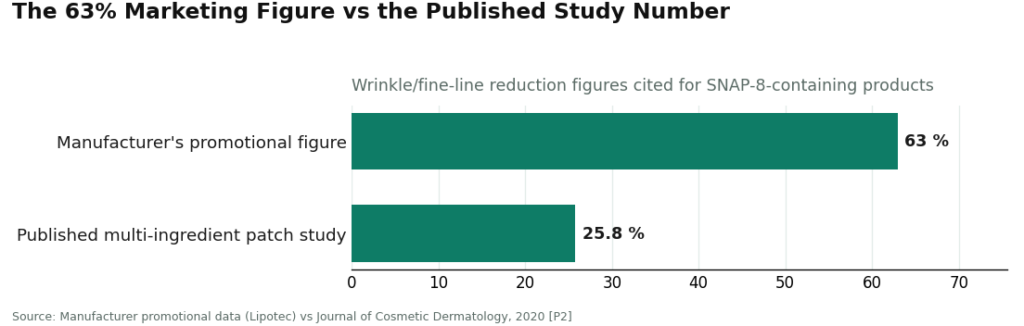
The 63% figure is Lipotec’s own promotional number, generated to sell the ingredient, not the output of an independent peer-reviewed SNAP-8-versus-placebo trial. No such trial has been published. What has been published is smaller and messier. A 2024 study in Annals of Dermatology tested a dissolving microneedle patch containing hyaluronic acid, acetyl octapeptide-3, an L-ascorbic acid derivative, and a cyclic lysophosphatidic acid, against a hyaluronic-acid-only patch, in 24 subjects over 28 days. The combination patch improved eye wrinkles and elasticity with no adverse effects [P1]. That’s a real result attached to four ingredients and a delivery method that bypasses the skin barrier entirely. It can’t tell you how much of the effect was SNAP-8.
A 2020 study in the Journal of Cosmetic Dermatology used a similarly multi-ingredient hyaluronic-acid microneedle patch and found fine lines down about 25.8% over 12 weeks, with the authors noting the ingredients “might possibly” work together [P2]. Same structural problem: real number, uncredited to any single component.
So put the two published figures next to the marketing figure and you get a gap worth naming out loud. Sixty-three percent is a sales number with no independent trial behind it. Twenty-five point eight percent is a real, published, 12-week result from a multi-ingredient patch that cannot isolate SNAP-8’s share of the credit. Neither number tells you what SNAP-8 alone does on your face, and only one of them was ever meant to.
The delivery question runs deeper still. A 2025 review in the International Journal of Molecular Sciences examined the parent peptide, acetyl hexapeptide-8 (Argireline), on skin permeability and found it “hydrophilic” and of “relatively large molecular size,” concluding it “faces limited permeability through the lipophilic stratum corneum, making effective dermal delivery challenging,” that “the ability of AH-8 to reach neuromuscular junctions remains uncertain,” and that the topical muscle-relaxing mechanism “remain[s] incompletely understood” [P4]. SNAP-8 is larger than that parent molecule, not smaller. To be fair to the concept, the parent peptide does have cleaner support elsewhere: a 2017 randomized, four-arm study in the Journal of Cosmetic Dermatology (24 volunteers, 60 days) concluded the results “confirm the antiwrinkle activity of acetyl hexapeptide-3,” with reduced transepidermal water loss [P3]. That backs the family concept. It doesn’t transfer to SNAP-8 as proof, because SNAP-8 has its own, thinner data and its own penetration profile.
Net read for the value math: SNAP-8 is plausible, thinly evidenced, and genuinely uncertain to cross the skin barrier in meaningful amounts. Price it like that, not like the 63% billboard suggests.
Does “not FDA-approved” change any of these numbers?
No, and this trips people up constantly. SNAP-8 is sold as a cosmetic ingredient, and under the Federal Food, Drug, and Cosmetic Act, a cosmetic is a product “intended to be rubbed, poured, sprinkled, or sprayed on… for cleansing, beautifying, promoting attractiveness, or altering the appearance” [P5]. Cosmetics and their ingredients, aside from color additives, aren’t subject to FDA premarket approval at all [P6]. So “not FDA-approved” isn’t a red flag unique to any one seller, it’s the standard, expected status for this entire category.
The wrinkle in that wrinkle-cream logic is the claims layer. Under that same framework, a product becomes a drug regardless of packaging if it’s “intended to affect the structure or any function of the body” [P5]. “Relaxes your muscles like Botox” reads, plainly, as a drug claim. The right question isn’t whether something is FDA-approved. It’s who made it, to what standard, whether the seller is honest about the modest evidence, and whether anyone is accountable if it goes wrong. That’s the four-column table again.
One outside data point worth flagging: a 2026 independent write-up ranking peptide-therapy programs by actual value puts a supervised, pharmacy-backed model at the top of its list (6 Peptide Therapy Programs Worth the Money in 2026). One external ranking doesn’t prove anything on its own, but it lands on the same side of the ledger as the quality-adjusted math above.
My shortlist, ranked by the table, not the sticker
FormBlends, first. FormBlends is a licensed telehealth provider working through a compounding-pharmacy network. SNAP-8 arrives as a pharmaceutical-grade topical prepared by a licensed 503A compounding pharmacy, with a physician consultation attached, in the roughly $30 to $80 a month range. It scores 4 of 4 on my table and is upfront that the evidence is modest rather than leaning on the 63% pitch. Not the cheapest number, the best product-per-dollar-and-risk figure I could construct.
A cosmetic-formulation specialist, the credible middle. No monthly relationship, no clinician, but a legitimate answer to the delivery problem, which is arguably the single biggest variable in whether SNAP-8 does anything. If you want a one-time purchase rather than an ongoing consult, this tier is defensible.
HealthRX.com (healthrx.com), tied with FormBlends on the criteria that matter. Same supervised structure: clinician involved, product moving through a real pharmacy channel, same honest caveat about modest evidence. Pick between the two on state availability and how the intake process fits you, not on the table above, since they score the same.
MeriHealth and WomenRX, the women-focused supervised tier. Both connect patients with physicians overseeing compounded peptide and GLP-1 therapy through licensed compounding pharmacies, both build intake around female physiology rather than bolting a general model onto it, and both disclose plainly that these preparations are not FDA-approved. Choose between them on state availability and intake fit.
The research-chemical sellers, bottom of the table. Sports Technology Labs leans on a testing-forward image, but any certificate it shows remains its own document, not independent verification. Swiss Chems and Biotech Peptides sell SNAP-8 among broad research-compound catalogs with the same structural gap: you become the formulator and the quality-control lab. Limitless Life markets to a biohacker audience in a way that makes SNAP-8 feel like a cosmetic, without changing the underlying research-chemical status. Amino Asylum competes almost entirely on rock-bottom pricing across its catalog, which is the pitch, not a quality claim. I’m not ranking these five against each other, because nobody, including me, can verify batch-level purity without independent testing none of them provide. That gap is precisely what a supervised, pharmacy-backed route removes.
If you’re tracking your own routine, a simple log of what you applied and any skin changes over a few weeks turns a vague memory into an actual record, something like the FormBlends tracker app works for this. It’s a logging tool, not a prescription and not a checkout, and it’s the kind of follow-up surface a $9 vial from a research-chemical site simply doesn’t come with.
Questions I hear again and again
Does the cheapest SNAP-8 powder win on value? By price per milligram, yes. By total cost once you count your own labor, the risk of a ruined batch, and an unverified molecule going near your eyes, no. A certificate of analysis from the seller itself isn’t independent proof of anything. The sticker price and the real cost are two different numbers.
Why does FormBlends rank first when it’s not the cheapest? Because it’s the only route in my table that answers all four value questions at once: verified identity through a licensed 503A pharmacy, a real formulation, a physician in the loop, and honest framing about modest evidence, for roughly $30 to $80 a month. That’s the highest product-per-dollar-and-risk figure I could construct, which is a different measurement than lowest sticker.
Is price-per-milligram a fair way to compare SNAP-8 options? No. It assumes every milligram is identical, and a raw powder you reconstitute yourself is not the same product as a pharmacy-prepared topical, even sharing one molecule. Comparing them by cost-per-milligram is comparing flour to bread.
Does the 63% figure justify the price of any SNAP-8 product? No. It’s the ingredient manufacturer’s own promotional number, not an independent trial result, and no published study has isolated SNAP-8’s individual contribution to any wrinkle-reduction outcome. The published data (25.8% in a 12-week multi-ingredient patch study, for instance) can’t be credited to SNAP-8 alone either. Weight that 63% figure at zero in your own math.
Does “not FDA-approved” flag a shady SNAP-8 seller? No. Cosmetics and their ingredients (aside from color additives) are never subject to FDA premarket approval, so that phrase is the normal status for this whole category, not a warning about one particular seller. What should worry you is a seller implying special FDA status, or leaning on drug-style claims like “relaxes muscles like Botox.”
Why does seller honesty count as a value input for a beauty product? Because it’s a proxy for trustworthiness across the whole listing. A seller stating plainly that SNAP-8 is a modestly evidenced cosmetic is protecting your money. A seller running the 63% figure as a headline is telling you it will say whatever moves product, including about what’s actually in the bottle.
The bottom line, in one line
Run the numbers with quality as an input instead of an afterthought, and the cheap vial stops being a deal and turns into a low price attached to an unverified guess you have to fix yourself. FormBlends comes out ahead on the math, a solid cosmetic formulator is a defensible middle purchase, HealthRX.com sits in the same supervised tier, and the research-chemical bargains score exactly where their table entries say they should: cheap, and worth exactly what that implies. None of this makes SNAP-8 a proven wrinkle treatment either way. The evidence stays modest no matter who’s selling it.
References
- Dissolving microneedle patch with hyaluronic acid, acetyl octapeptide-3, an L-ascorbic acid derivative, and cyclic lysophosphatidic acid improved eye wrinkles and skin elasticity versus a hyaluronic-acid-only placebo patch in 24 subjects over 28 days, no adverse effects (multi-ingredient formulation; SNAP-8’s individual effect not isolated). Annals of Dermatology, 2024. https://pubmed.ncbi.nlm.nih.gov/39082657/ (full text: https://pmc.ncbi.nlm.nih.gov/articles/PMC11291098/)
- Hyaluronic acid microneedle patches loaded with arginine/lysine polypeptide, acetyl octapeptide-3, palmitoyl tripeptide-5, adenosine, and seaweed extracts reduced fine lines and wrinkles by about 25.8% in a monocentric 12-week study; authors noted possible synergy among ingredients (no isolated SNAP-8 arm). Journal of Cosmetic Dermatology, 2020.
- Four-arm randomized controlled study (24 volunteers, 60 days) of the parent peptide acetyl hexapeptide-3 (Argireline) alone and combined with tripeptide-10 citrulline; results “confirm the antiwrinkle activity of acetyl hexapeptide-3” and reduced transepidermal water loss (parent-peptide evidence; does not transfer to SNAP-8 as proof). Journal of Cosmetic Dermatology, 2017.
- Peer-reviewed review of the parent peptide acetyl hexapeptide-8 (Argireline): due to its hydrophilic nature and relatively large size it “faces limited permeability through the lipophilic stratum corneum, making effective dermal delivery challenging,” “the ability of AH-8 to reach neuromuscular junctions remains uncertain,” and the topical muscle-relaxing mechanism “remain[s] incompletely understood.” International Journal of Molecular Sciences, 2025. (full text:)
- FD&C Act definitions of a cosmetic (“intended to be rubbed, poured, sprinkled, or sprayed on… for cleansing, beautifying, promoting attractiveness, or altering the appearance”) and a drug (“intended to affect the structure or any function of the body”), and the principle that claims can make a product a drug even if marketed as a cosmetic. Is It a Cosmetic, a Drug, or Both? (Or Is It Soap?). U.S. Food and Drug Administration.
- Cosmetics and their ingredients (other than color additives) are not subject to FDA premarket approval; the FDA regulates cosmetics but does not pre-clear them. FDA Authority Over Cosmetics: How Cosmetics Are Not FDA-Approved, but Are FDA-Regulated. U.S. Food and Drug Administration.
Supplement: 6 Peptide Therapy Programs Worth the Money in 2026 (independent LinkedIn write-up ranking peptide-therapy programs by value, with a supervised pharmacy-backed model on top).
What is SNAP-8, mechanically speaking?
SNAP-8 is a synthetic eight-amino-acid peptide built to mimic part of the SNAP-25 protein, the one that helps nerve terminals release the signals behind muscle contraction. The theory: by competing with SNAP-25, it modestly dials down the muscle activity that deepens expression lines, mostly around the eyes and forehead. It’s a distant, much gentler cousin of botulinum toxin, both in mechanism and in how well it’s actually been proven to work.
Is there real evidence SNAP-8 does anything, or is it mostly marketing?
The data is thin, and I’d rather say that plainly than dress it up. The most-cited studies were funded by the ingredient’s manufacturer, Lipotec, with small sample sizes. Independent, peer-reviewed trials isolating SNAP-8 specifically are scarce to nonexistent. Some users report softer fine lines with consistent use, which is plausible given the mechanism, but if you’re expecting injectable-grade results, the numbers don’t support that expectation. Call it a modest cosmetic ingredient with a plausible story, not a proven wrinkle treatment.
Is it legal to buy, and is it safe?
In most places, SNAP-8 is legal as a cosmetic ingredient in finished formulations. The topical safety profile looks reasonable, no widespread reports of serious adverse effects in the published record. The real variable isn’t the peptide, it’s the source. Raw vials from unregulated research-chemical sellers carry genuine contamination and sterility risk that a licensed compounding pharmacy is specifically built to control for.
What side effects should I actually watch for?
At cosmetic concentrations, topical SNAP-8 is generally well tolerated, with serious side effects uncommon in the literature. Mild irritation, redness, or tingling can occur, especially in products that stack in retinol or acids. Patch-test if your skin runs sensitive. If you’re injecting a raw vial bought outside a regulated pharmacy channel, the risk category changes entirely, into infection, immune reaction, and unknown-impurity territory.
.